
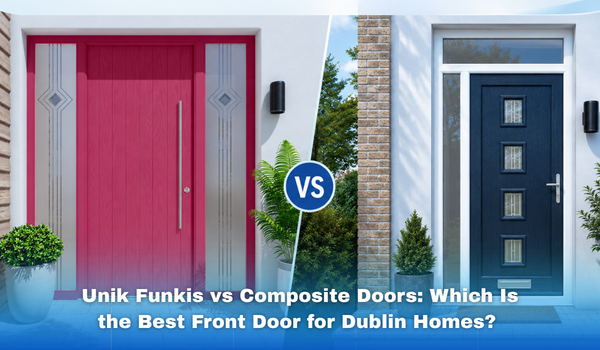
Choosing a new front door for your Dublin home is a bigger decision than it might first seem. Your front door is the first thing visitors notice, the first line of defence against break-ins, and a key factor in how much heat your home holds onto during the long Irish winter. Get it right and you will not be thinking about it again for decades.
Right now, two door types are getting a lot of attention from Dublin homeowners: Unik Funkis doors and composite doors. Both have genuine strengths, but they suit different homes, different budgets, and different priorities. This guide breaks down exactly how they compare across four areas that matter most – security, thermal performance, looks, and lifespan – so you can make a clear, informed decision.
If you would like to see both options in person before committing, visit the Thermoglaze showrooms in Swords and Rathgar or call 01 912 0600 to speak with the team.
What Is a Unik Funkis Door?
A Unik Funkis door is a Scandinavian-designed door system built for homes where clean lines and strong performance go hand in hand. The range is built around a timber core with aluminium cladding on the exterior face, giving it a hard-wearing outer skin that handles the Irish coastal climate without fading, warping, or corroding over time.
The design language is minimal – flat panels, concealed hinges, narrow sight lines, and a choice of contemporary colours and glazing options. These are not traditional panel doors. They suit modern builds, architect-designed homes, and any property where the owner wants a door that looks like it belongs on a house built in the last ten years.
Thermoglaze supplies and installs Unik Funkis doors across Dublin, and the range can be viewed at either showroom location.
What Is a Composite Door?
A composite door is built from several materials bonded together – typically a solid foam core, a GRP (glass-reinforced plastic) outer skin, a timber sub-frame, and a PVC or aluminium frame around the edge. The result is a door that is heavier and more solid than a standard uPVC door, with a surface that can be moulded to look like painted timber.
Composite doors are the most popular front door choice in Ireland right now, largely because they come at a wide range of price points and in hundreds of styles – from Georgian panel doors to more contemporary flush designs. They are a practical, well-proven option for the majority of Dublin homes.
Head-to-Head Comparison: Unik Funkis vs Composite Doors
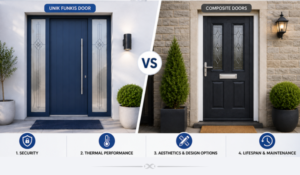
1. Security
Both door types offer solid security, but they approach it differently.
Unik Funkis doors use a multi-point locking system with heavy-duty hardware throughout. The aluminium-clad exterior resists physical attack, and the door leaf itself is dense enough that forcing entry is genuinely difficult. The concealed hinge design also removes a common weak point found on traditionally hung doors.
Composite doors are fitted with multi-point locks as standard and pass the same PAS 24 security testing required for new-build homes in Ireland and the UK. The GRP skin is impact-resistant, though it can be vulnerable to sustained force in a way that aluminium cladding generally is not.
For high-security applications or homes in areas with elevated break-in risk, the Unik Funkis system has a slight edge. For the average Dublin home, a good-quality composite door is more than adequate.
2. Thermal Performance
This is where Unik Funkis doors pull noticeably ahead.
The timber-aluminium construction of the Unik Funkis range delivers U-values well below what most composite doors achieve. U-value measures how much heat passes through a material – the lower the number, the better the insulation. Scandinavian door systems are engineered to handle far colder winters than anything Dublin sees, so thermal performance is built into the design from the ground up.
If your home is going through a broader energy upgrade and you are looking to qualify for an SEAI grant, the thermal specification of your door matters. Unik Funkis doors are more likely to meet the required performance thresholds comfortably than a standard composite option.
Composite doors with a solid foam core are a meaningful upgrade on older timber or uPVC doors, but they do not reach the same thermal standard as a premium European door system like Unik Funkis.
3. Aesthetics and Design Options
This comes down to the style of your home.
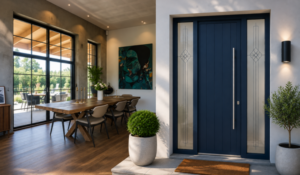
Unik Funkis doors are built for contemporary architecture. If your home has large windows, a flat or low-pitch roof, or a generally modern character, a Unik Funkis door will look like it was always supposed to be there. The range offers:
- Flush and near-flush panel configurations
- Large glazing options including full-height glass inserts
- A wide palette of RAL colours, including dark tones that are hard to achieve in composite
- Concealed hardware for a clean, uninterrupted finish
Composite doors cover a much broader style range – from traditional raised-panel designs that suit period terraces in Rathgar or Drumcondra, through to contemporary flush composites that sit alongside modern builds. If you need a door that mimics the look of painted timber on a Victorian or Edwardian home, composite is the more natural fit.
4. Lifespan and Maintenance
Unik Funkis doors are built to last. The aluminium exterior does not need painting, does not fade in UV light, and does not corrode in the salt air that affects properties close to the coast – a real consideration for homes in Clontarf, Raheny, or along the Southside shore. The timber core is protected entirely by the outer skin, so the structural integrity of the door is not affected by Irish weather over time.
Composite doors also have a good lifespan – typically 25 to 35 years with reasonable care. The GRP skin can occasionally fade or chalk after many years of UV exposure, though modern composites are significantly better in this respect than earlier versions. Cleaning with a damp cloth a few times a year is usually all that is needed.
Both options are low-maintenance relative to traditional timber doors, but the Unik Funkis system requires virtually nothing beyond occasional cleaning
Unik Funkis vs Composite Doors: Quick Comparison Table
| Feature | Unik Funkis Door | Composite Door |
| Composite Door | Timber core + aluminium exterior cladding | Foam core + GRP skin + timber sub-frame |
| Security | Multi-point lock, concealed hinges, aluminium-clad leaf – very high impact resistance | Multi-point lock, PAS 24 certified – strong for most applications |
| Thermal Performance | Excellent – low U-values built into Scandinavian design | Good – solid foam core improves on uPVC but does not match Unik Funkis |
| SEAI Grant Eligibility | Highly likely to meet thermal thresholds | Possible depending on spec – check before purchasing |
| Design Style | Contemporary and minimal – suits modern homes | Traditional to contemporary – suits a wide range of Dublin home types |
| Colour Options | Full RAL palette including deep, dark tones | Wide range – some dark tones can fade on cheaper models |
| Glazing Options | Large inserts including full-height glass panels | Standard inserts – full-height glass less common |
| Hardware | Concealed hinges, flush pulls, minimal visible fixings | Visible hinges and handles as standard |
| Maintenance | Very low – aluminium exterior needs only occasional cleaning | Low – damp cloth clean a few times per year |
| Lifespan | 30+ years with minimal upkeep | 25–35 years with reasonable care |
| Salt Air / Coastal Resistance | Excellent – aluminium cladding does not corrode | Good – GRP skin resists moisture but frame edges need monitoring |
| Best Suited To | Modern builds, architect-designed homes, high-spec renovations | Period homes, traditional terraces, mid-range renovations |
| Price Point | Premium | Mid-range to premium depending on brand and spec |
Which Door Is Right for Your Dublin Home?
Here is a straightforward way to think
about it:
- Choose a Unik Funkis door if you have a modern or contemporary home, prioritise thermal efficiency, want aluminium-level durability, or are going for a high-spec finish.
- Choose a composite door if you have a traditional or period home, are working to a tighter budget, or want a wide range of panel styles and colour options.
Either way, the most important step is getting the installation right. A poorly fitted door – regardless of how good the product is – will underperform on every measure. Thermoglaze installs both door types across all Dublin postcodes, with experienced fitters who have worked on everything from city-centre apartments to large detached homes in the suburbs.
Get a Free Quote Today
Ready to replace your front door? Contact Thermoglaze on 01 912 0600 or request a free quote. You can also visit either of our Dublin showrooms to see Unik Funkis and composite doors side by side before making a decision.
Visit Our Dublin Showrooms
Both showrooms are open to the public. No appointment needed – walk in and the team will take you through the options.
- Swords Showroom – Unit F2, Swords Enterprise Park, Feltrim Road, Swords, Co. Dublin, K67 WF72
- Rathgar Showroom – 68 Rathgar Avenue, Rathgar, Dublin 6, D06 KN53
Call ahead if you want to arrange a time with a product specialist.
Conclusion
Both Unik Funkis doors and composite doors are solid choices for Dublin homes – the right one depends on your property type, your performance priorities, and how long you want the door to last without attention.
If thermal efficiency, modern design, and long-term durability are at the top of your list, Unik Funkis is the stronger option. If you need a versatile door that works across a wide range of home styles and budgets, a well-specified composite door will serve you well.
The Thermoglaze team has fitted both across Dublin for years. They can walk you through the specs, show you samples in the showroom, and give you an honest recommendation based on your specific home. Call 01 912 0600 or visit thermoglaze.ie to get started.
FAQs
1. What is the main difference between a Unik Funkis door and a composite door?
A Unik Funkis door uses a timber core with an aluminium exterior cladding, giving it superior thermal performance and a distinctly contemporary look. A composite door is made from a mix of materials – foam core, GRP skin, and a timber sub-frame – and is available in a wider range of traditional and modern styles at varying price points.
2. Which door type offers better insulation for Irish winters?
Unik Funkis doors generally deliver better U-values than standard composite doors, making them the stronger choice if energy efficiency is your primary concern. The Scandinavian design heritage of the system means thermal performance is a core part of the engineering, not an afterthought.
3. Are Unik Funkis doors suitable for older Dublin homes?
Unik Funkis doors are best suited to contemporary or modern homes where their minimal design looks at home. For period properties in areas like Rathgar, Drumcondra, or Donnybrook, a composite door with traditional panel styling is usually a better visual fit.
4. How long does a Unik Funkis door last?
With proper installation and basic cleaning, a Unik Funkis door can last well over 30 years. The aluminium exterior is UV-stable and corrosion-resistant, so the door will not fade, warp, or degrade the way unprotected timber or uPVC can over time.
5. Do composite doors need much maintenance?
Composite doors are very low maintenance. A wipe down with a damp cloth a few times a year is usually enough. Avoid harsh chemical cleaners on the GRP skin, and check the frame and hardware annually to keep everything in good working order.
6. Can I get an SEAI grant for either door type?
Yes, both door types can qualify for SEAI grant support, subject to meeting the required thermal performance specifications. The SEAI grant scheme for windows and doors in Ireland is worth checking before you finalise your decision, as it can reduce the upfront cost significantly.
7. Which door type is more secure?
Both Unik Funkis and composite doors offer strong security with multi-point locking systems as standard. Unik Funkis doors have a slight edge in impact resistance due to the aluminium cladding. For most Dublin homes, either option is well above adequate when correctly installed.
8. Can I see both door types in person before buying?
Yes. Thermoglaze has showrooms in Swords and Rathgar where you can view both Unik Funkis and composite doors and speak with the team about your specific requirements. No appointment is needed.
9. How long does front door installation take?
In most cases a single front door replacement takes between half a day and a full day, depending on the existing frame condition and whether any structural adjustments are needed. The Thermoglaze fitting team will give you a time estimate when you book.
10. How do I get a quote for a new front door in Dublin?
Call Thermoglaze on 01 912 0600 or visit ThermoGlaze to request a free quote. The team covers all Dublin postcodes and surrounding areas.