
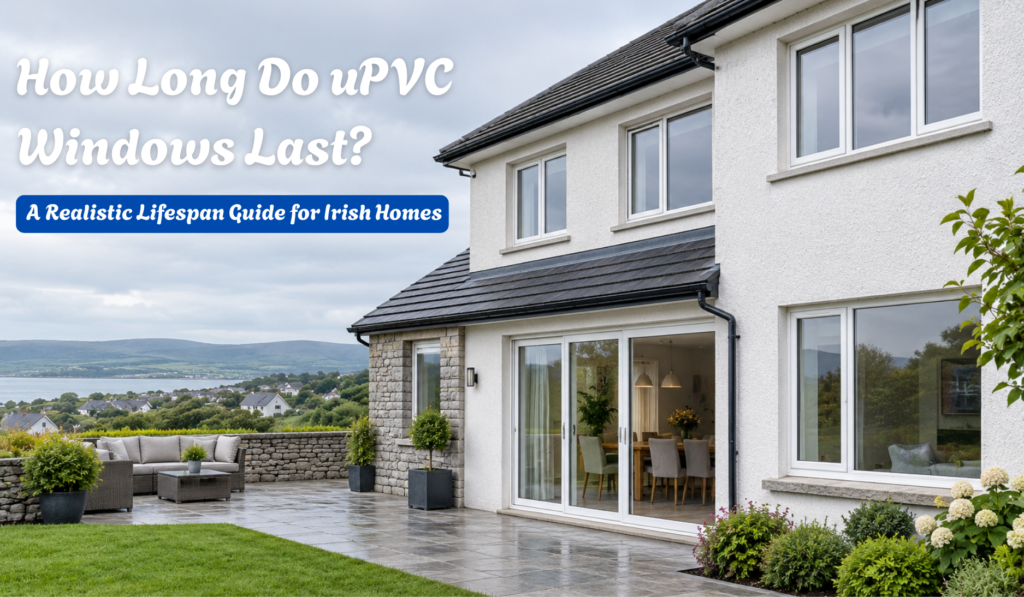
uPVC windows typically last between 20 and 35 years in Irish homes. The frame itself can last the full duration with basic care. The sealed glazing unit may need replacing earlier, and hardware such as hinges and locks generally needs attention before the frame does.
Lifespan depends on installation quality, the grade of uPVC used, coastal exposure, and basic maintenance.
What is uPVC?
uPVC stands for unplasticised polyvinyl chloride. Unlike standard PVC, it contains no plasticisers, which keeps it rigid and stable over time. It does not rot, warp, rust, or corrode – making it well suited to Ireland’s damp, maritime climate.
Why uPVC Windows Suit the Irish Climate?
Ireland’s weather is mild but persistently wet, with high humidity and regular rain year-round. Coastal properties also deal with salt-laden air that accelerates corrosion in exposed materials.
uPVC handles all of this well at a material level. The frame does not absorb water, swell, or decay. That is why
became the dominant choice for Irish homeowners from the 1990s onwards. They require far less upkeep than timber in this climate and hold their shape and performance for decades when correctly installed.
At ThermoGlaze, our installation teams have fitted uPVC windows in Dublin homes ranging from 1960s semi-detached houses in Drumcondra to new builds in Swords – and the pattern is consistent: windows installed correctly and given basic care routinely reach and exceed the 25-year mark.
uPVC Window Lifespan: Component by Component
Not every part of a uPVC window ages at the same rate. Understanding this saves homeowners from unnecessary full replacements.
| Component | Typical Lifespan | Notes |
| uPVC frame | 25–35+ years | Longer with quality profile and correct fitting |
| Sealed double glazing unit | 15–25 years | Fogging between panes signals seal failure |
| Hardware (hinges, handles, locks) | 10–20 years | Annual lubrication extends this significantly |
| Weather seals / gaskets | 10–15 years | Replaceable without changing the full frame |
| Frame colour / finish | 20+ years | Better on UV-stabilised profiles |
The frame and the glass unit are separate components with different service lives. A failed glazing unit does not mean the entire window needs replacing. In the majority of cases, only the glass unit is swapped – which is a faster and more affordable fix.
What Makes Some uPVC Windows Last Longer Than Others?
Profile Quality
Multi-chambered uPVC profiles with galvanised steel reinforcement last significantly longer than single-chamber budget profiles. Corner welds are the most common early failure point on lower-grade windows – a well-welded corner on a quality profile holds firm for the life of the frame.
Modern uPVC profiles are also lead-free and UV-stabilised, which prevents the yellowing and brittleness seen on older windows from the 1980s and early 1990s.
Installation Quality
This is the factor homeowners most often underestimate. A quality window fitted poorly will fail before a mid-range window fitted correctly. Poor installation introduces water ingress at the reveal, frame misalignment that strains the hardware, and gaps in the perimeter seal that cause draughts from day one.
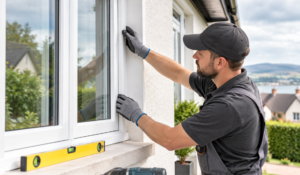
Professional installation – with correct sealing, levelling, and drainage – is as important as the product itself.
If your existing windows are showing signs of wear, request a free assessment from ThermoGlaze and we’ll tell you honestly whether repair or replacement is the right call.
Coastal and Exposed Locations
Properties within a few kilometres of the Irish coastline deal with salt air that corrodes metal components faster than inland locations. The uPVC frame itself is unaffected, but hinges, friction stays, and multi-point locking mechanisms may need more frequent lubrication and earlier replacement. Specifying stainless or marine-grade hardware at the point of installation adds years to the window’s working life in exposed positions.
Maintenance
Low maintenance is one of uPVC’s genuine advantages – but it is not zero maintenance. Windows that are cleaned regularly and have their hardware lubricated once a year will outlast neglected ones by a meaningful margin. Seized hinges and failed seals are almost always preventable with basic annual attention.
Signs Your uPVC Windows Are Failing
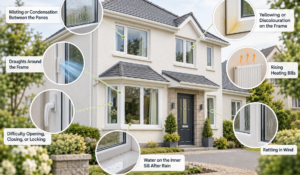
Knowing what to look for helps homeowners act before problems compound:
- Misting or condensation between the panes – the glazing unit seal has broken down
- Draughts around the frame – perimeter seals have deteriorated or the frame has moved
- Difficulty opening, closing, or locking – hardware wear or frame distortion
- Yellowing or discolouration on the frame – a sign of older or lower-grade uPVC
- Rising heating bills without another obvious cause – the window is no longer insulating adequately
- Water on the inner sill after rain – water is bypassing the seal into the reveal
- Rattling in wind – glazing bead has loosened or the unit has shifted in the frame
If three or more of these are present at the same time, full replacement is usually more cost-effective than a series of individual repairs.
When to Repair and When to Replace?
| Situation | Recommended Action |
| Fogging between panes only | Replace glazing unit only |
| Handle or hinge failure | Replace hardware only |
| Perimeter seal draught | Replace gaskets first |
| Frame visibly cracked or distorted | Full window replacement |
| Multiple issues at once | Full replacement more cost-effective |
Can the SEAI Grant Cover uPVC Window Replacement?
Yes – uPVC window replacement can qualify under the SEAI windows and doors grant where the upgrade forms part of a broader home energy improvement and the new windows meet the required thermal performance standard.
If your current windows are single glazed or early double glazed, replacing them with modern uPVC units delivers a measurable improvement in heat retention. That improvement feeds into your home’s BER rating, which is increasingly relevant for property value and mortgage eligibility in Ireland. Checking your SEAI grant eligibility before committing to any replacement work is always worth doing.
Conclusion
Well-installed uPVC windows give an Irish home 20 to 35 years of reliable service – often more with proper care. The frame outlasts the glass unit in most cases, and many homeowners only need to replace the sealed unit rather than the entire window.
ThermoGlaze has been supplying and installing uPVC windows across Dublin for years, with teams who understand how Irish weather, building stock, and planning requirements affect the right product choice. Every installation comes with a full product warranty and professional fitting by experienced tradespeople.
If your windows are approaching the end of their life, or you want a clear, honest assessment of where they stand, get in touch. We cover all of Dublin from our two showrooms.
Visit us in person:
- Swords: Unit F2, Swords Enterprise Park, Feltrim Road, Drinan, Swords, Co. Dublin, K67 WF72
- Rathgar: 68 Rathgar Avenue, Dublin 6, D06 KN53
FAQs
1. How long do uPVC windows last in Ireland?
Between 20 and 35 years in most Irish homes. The frame generally outlasts the sealed glazing unit, and basic maintenance pushes the upper end of that range.
2. Do uPVC windows yellow over time?
Older and lower-grade profiles can yellow after 10 to 15 years. Modern UV-stabilised uPVC holds its colour for 20 years or more under normal Irish conditions.
3. Can you repair uPVC windows rather than replace them?
Often yes. Failed glazing units can be reglazed without touching the frame. Handles, hinges, and locks are all individually replaceable. Full frame replacement is only needed when the frame itself is cracked or structurally compromised.
4. What causes condensation between uPVC window panes?
It means the seal within the glazing unit has failed, allowing moisture into the cavity. This is a glass unit failure, not a frame failure, and can usually be resolved by replacing the unit alone.
5. Are uPVC windows energy efficient?
Yes. Modern uPVC double and triple glazing delivers strong thermal insulation, reduces heat loss, and contributes positively to a home’s BER rating – particularly when replacing single glazing or early double glazing.
6. How much maintenance do uPVC windows actually need?
Very little. Lubricate the hinges and locks once a year, clean the frames two or three times a year with a mild detergent, and keep the drainage channels clear. That covers the vast majority of what’s needed.
7. Does the SEAI grant cover uPVC window replacement?
It can, where the replacement meets the required thermal performance standard and forms part of a broader home energy upgrade. Full eligibility details are available on the SEAI grant page.
8. What is the first part of a uPVC window to typically fail?
Usually the hardware – hinges and locking mechanisms – followed by the perimeter seals and gaskets. The uPVC frame itself is almost always the last component to show any deterioration.
9. How do I know if my uPVC window needs replacing or just repairing?
If the issue is isolated – fogging glass, a stiff handle, a draught from one seal – repair is usually the right call. If you are dealing with multiple problems at once, or the frame is visibly distorted, replacement is more cost-effective in the long run.
10. How do I get a quote for uPVC window replacement in Dublin?
Call 01 912 0600, visit ThermoGlaze.ie, or come into our Swords or Rathgar showrooms. We’ll give you a clear, honest recommendation with no obligation.