
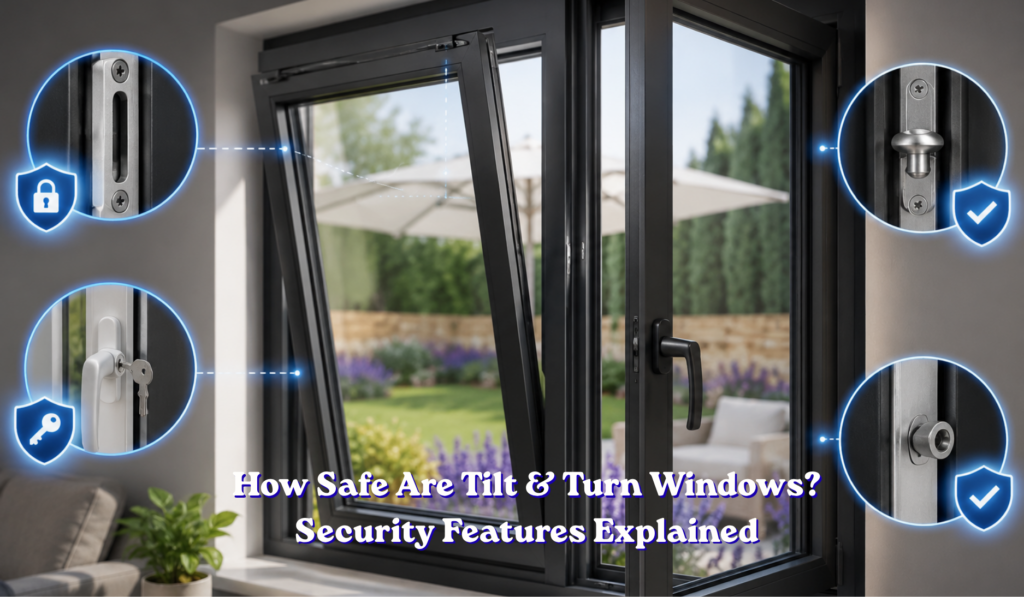
Old windows are one of the easiest ways into a house, a single pane of glass, one flimsy latch, and a few seconds with a screwdriver is sometimes all it takes. That’s exactly why so many Dublin homeowners are switching to tilt & turn windows when they replace their windows – not just for the clean European look, but for the security built into every frame.
At Thermoglaze, we get asked one question more than any other: “are tilt and turn windows actually secure?” The short answer is yes, when they’re fitted properly and built with the right hardware. Here’s what actually makes them safe, and what to check before you buy.
What Are Tilt & Turn Windows?
Tilt & turn windows open in two separate ways, controlled by a single handle:
- Tilt mode – the top of the sash tilts inward a few inches, letting air in while the window stays locked against the frame
- Turn mode – the whole window swings inward like a door, giving full access for cleaning or maximum airflow
That double function is why they’ve become so popular in apartments, bedrooms, and upper floors across Dublin – you get fresh air on a warm night without leaving the house wide open.
Why Does Window Security Actually Matters?
Windows account for a large share of break-in attempts on Irish homes, particularly ground-floor windows and older units with single-point latches. The weak points usually come down to:
- Single-point locks that snap or get forced with a flat tool
- Thin, unreinforced frames that flex under pressure
- Standard glass that breaks with one sharp knock
- Hinges that can be lifted out from the outside
A tilt & turn window deals with most of these problems by design, not as an add-on extra.
The Security Features That Make Tilt & Turn Windows Safe
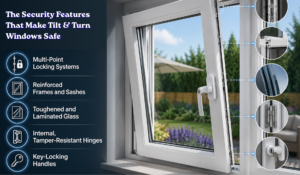
Multi-Point Locking Systems
Instead of one latch, a tilt & turn window locks at several points around the frame at the same time – often five to eight, depending on the size. Turning the handle drives mushroom-shaped cams into steel along the frame, so prying one corner does nothing; the rest of the locks hold firm.
Reinforced Frames and Sashes
Behind the uPVC or aluclad profile, there’s a steel or aluminium reinforcement running through the frame. That’s what stops a window from bending or cracking under force, which is usually how a break-in attempt starts.
Toughened and Laminated Glass
Standard glass is the weakest part of any window. Toughened glass takes far more force to break, and laminated glass holds together even when cracked, thanks to an interlayer bonded between two panes. Either option turns a smash-and-grab attempt into something loud, slow, and obvious to anyone nearby.
Internal, Tamper-Resistant Hinges
Hinges sit inside the frame rather than exposed on the outside, so there’s nothing for an intruder to unscrew or lever from the street side.
Key-Locking Handles
A lockable handle adds a second layer on top of the multi-point system – useful for ground-floor rooms, side windows, or anywhere children might reach the handle.
Tilt Mode: Ventilation Without Leaving the House Open
This is the part people don’t expect. In tilt mode, the window is still locked into the frame – it’s just open a few inches at the top. You get fresh air through the night or while you’re out running errands, without the gap being wide enough for anyone to climb through. It’s the main reason tilt & turn has overtaken older opening styles for bedrooms and upstairs rooms.
More Than Just Security
Security is the headline, but it’s not the only reason homeowners choose this window style:
- Energy efficiency – the tight multi-point seal cuts draughts and heat loss
- Easy cleaning – turn mode brings the outer glass face inside, no ladder needed
- Durability – steel-reinforced frames and quality hardware hold up for decades, not years
- Look – clean, slim sightlines that suit both period and modern Dublin homes
If you’re weighing this up against a grant-backed upgrade, check the SEAI windows and doors grant before you decide – it can take a real chunk off the cost of replacing old, draughty windows.
How Do They Compare to Other Window Styles?
| Window type | Locking points | Typical weak spot |
| Tilt & turn | Multi-point (5–8) | None when fitted correctly |
| Casement | Usually single-point | Hinge side can be levered |
| Sliding | Single latch | Track can be lifted or forced |
If security is the priority, tilt & turn windows outperform casement windows and sliding styles on locking alone – though both have their place depending on the room and the look you’re after.
Choosing the Right Tilt & Turn Windows for Your Home
Not every tilt & turn window on the market is built the same. The frame material changes both the security and the lifespan:
- uPVC windows – the most cost-effective option, strong and low-maintenance
- Aluclad windows – aluminium outside, timber inside, built for higher exposure and a sharper finish
- Aluminium windows – slim frames, very strong, suited to larger glass panels
Before you buy, ask the supplier directly about the locking points, the glass spec, and whether the hardware has been tested to a recognised security standard. If they can’t answer clearly, that’s worth noting.
See Them in Person Before You Decide
Specs on a page only tell you so much. The best way to judge a tilt & turn window is to operate one yourself – feel the weight of the handle, hear the locks engage, and compare the glass options side by side. You can do exactly that at either of our showrooms:
- Swords Showroom – Unit F2, Swords Enterprise Park, Feltrim Rd, Drinan, Swords, Co. Dublin, K67 WF72
- Rathgar Showroom – 68 Rathgar Avenue, Rathgar, Dublin 6, D06KN53
Or call us directly on 019120600 and we’ll talk you through what suits your home best.
Conclusion
A tilt & turn window isn’t secure because of one clever feature – it’s the combination of multi-point locks, reinforced frames, tougher glass, and hidden hinges all working together. Fitted correctly, it’s one of the strongest window styles available for an Irish home, and it still gives you the ventilation and easy cleaning that make daily life easier.
If your current windows are old enough that you’re not sure how they’d hold up, that’s usually the sign it’s time to look at replacing them. Get a free quote from Thermoglaze, visit one of our showrooms, or call 019120600 – we’ll give you a straight answer on what your home needs, no pressure attached.
FAQs
1. Are tilt & turn windows actually secure?
Yes. They lock at multiple points around the frame at once, which makes them far harder to force open than a window with a single latch.
2. Can a tilt & turn window stay locked while in tilt mode?
Yes. Tilt mode keeps the sash engaged with the frame, so you get ventilation without disengaging the security hardware.
3. What glass should I choose for the best security?
Toughened or laminated glass. Laminated glass is generally the stronger choice for ground-floor rooms since it holds together even when cracked.
4. Do tilt & turn windows meet a recognised security standard?
Many can be specified to meet European burglary resistance ratings such as RC2, depending on the handle, hinges, and glass chosen. Ask your supplier to confirm before ordering.
5. Are tilt & turn windows good for upstairs bedrooms?
Yes, and they’re a popular choice for bedrooms specifically because tilt mode allows safe overnight ventilation.
6. Do these windows work for ground-floor rooms too?
Yes. For ground-floor rooms, ask about adding a key-locking handle and laminated glass as extra layers of protection.
7. How many locking points should I look for?
Most quality tilt & turn windows have between five and eight locking points, depending on the size of the window.
8. Are uPVC tilt & turn windows as secure as aluminium ones?
Both can be highly secure when reinforced and fitted with quality hardware. Aluminium frames are generally stronger overall, but uPVC with steel reinforcement holds up well too.
9. Can I see tilt & turn windows in person before ordering?
Yes. Visit our Swords or Rathgar showroom to see the locking mechanism, glass options, and frame finishes up close.
10. How much do tilt & turn windows cost in Ireland?
Cost depends on size, frame material, and glass spec. The best way to get an accurate number is a free quote – call 019120600 or request a quote online.