
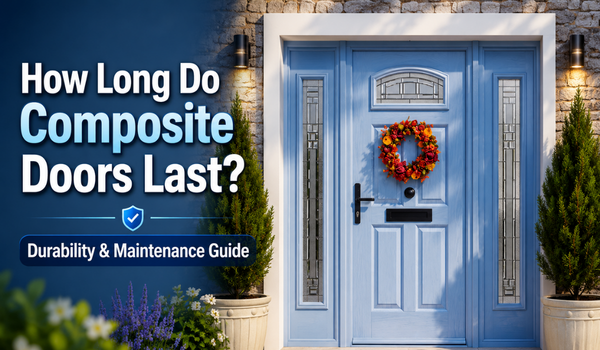
Your front door takes a beating every day – rain, wind, sun, slamming, key turns, kids running in and out – and it’s still expected to look sharp and keep your home secure. If you’re weighing up a new front door, “how long will it actually last” is a fair question to ask before you spend the money.
At Thermoglaze, we fit composite front doors across Dublin and we get asked about lifespan and upkeep almost every week. Here’s a straight answer, plus how to get the most years out of your door once it’s fitted.
What Is a Composite Door Made From?
A composite door isn’t one material – it’s several, bonded together so each one covers the others’ weak points:
- A solid timber core for strength and rigidity
- High-density insulating foam for thermal performance
- A GRP (glass-reinforced plastic) or uPVC outer skin that won’t rot, swell, or warp
- A reinforced frame around the edges for added security
Because the outer skin is weatherproof and the core is sealed, the door doesn’t absorb moisture or move with the seasons the way timber does, and the finish doesn’t need repainting every few years. That’s the main reason composite doors hold up so well over time.
How Long Do Composite Doors Last?
With decent installation and a small amount of upkeep, most composite doors give somewhere between 25 and 35 years of reliable service – well beyond a standard painted timber door, which usually needs replacing or repairing within 10 to 15 years once the wood cracks, swells, or rots at the bottom edge.
Where your door lands in that 25-35 year window depends on:
- The quality of the door itself (slab thickness, core type, hardware grade)
- How well it was installed and aligned in the frame
- How exposed it is to direct sun, rain, or salt air
- How consistently it gets basic care
A door fitted properly and lightly maintained will comfortably outlast one left to fend for itself, so it’s worth taking the time to compare our full range of doors before settling on a style.
What Shortens a Composite Door’s Lifespan?

A few common culprits cause composite doors to wear out faster than they should:
- Poor installation – a door fitted slightly out of square drags on its hinges and strains the lock for years.
- South-facing exposure – constant direct sun can fade colour and stress the outer skin faster.
- Dark colours in full sun – darker finishes absorb more heat, wearing seals out sooner.
- Neglected hardware – stiff hinges, dry locks, and worn seals usually fail long before the door slab itself.
- High footfall – a busy family front door takes more wear than a side or garden door.
None of these are reasons to avoid a composite door – just things worth knowing so you can plan around them.
Signs Your Composite Door Needs Attention
Catching small issues early is what stretches a door’s lifespan, and most homeowners only need to glance over their front door a couple of times a year to stay ahead of problems. Watch for:
- A noticeable draught around the edges when closed
- The door sticking, dragging, or needing a shoulder to shut
- Visible fading or chalking on the surface colour
- Condensation building up between the door and frame
- A key getting harder to turn, or a loose-feeling handle
Most of these are simple fixes – a hinge adjustment, a new seal, a bit of lock lubrication – rather than signs you need a full replacement. If something feels off and you’re not sure whether it’s a quick fix or a bigger problem, it’s worth getting in touch with our team for an honest opinion before it gets worse.
Composite Door Maintenance: What Actually Keeps It Lasting?

-
Cleaning the Door Slab
Wipe the surface every few weeks with warm water and a mild detergent, then dry with a soft cloth. Avoid bleach, abrasive pads, or solvent-based cleaners, which can dull the finish.
-
Looking After Hinges, Locks, and Handles
A light application of a door-friendly lubricant (not WD-40, which attracts dust) on hinges and the lock mechanism twice a year keeps everything moving smoothly and prevents premature wear.
-
Checking Seals and Weatherstripping
Run a hand along the rubber seals once or twice a year. Flat, cracked, or stiff seals are due for replacement – one of the cheapest ways to stop draughts and protect the frame underneath.
-
Re-Aligning Hinges When Needed
Hinges loosen slightly over years of use. A quick screw tightening or hinge adjustment keeps the door sitting snugly in the frame, protecting both the seals and the lock.
-
A Quick Seasonal Check
Before winter, test the lock, check the seals, and clear the drainage track at the bottom of the frame so rainwater isn’t sitting against it. A door that’s well looked after also performs better thermally, which matters if your project might qualify for the SEAI grant scheme on energy-efficient upgrades.
Composite Doors vs uPVC and Timber Doors
If you’re weighing up your options, composite doors generally come out ahead on long-term durability:
- Timber doors look classic but need repainting or varnishing every few years and are prone to swelling in wet weather.
- uPVC doors are low-maintenance and budget-friendly, though the slab isn’t quite as rigid or impact-resistant as a composite door’s timber-and-foam core. We fit both – see our uPVC doors range if budget is the priority.
- Composite doors sit a little higher on price but ahead on durability, security, and how little attention they need.
Why Dublin Homeowners Choose Thermoglaze Composite Doors?
We supply and fit composite doors built for Irish weather, with a focus on:
- Genuine durability and impact strength
- Multi-point locking for proper security
- Strong thermal performance, which pairs well with the SEAI grant scheme if you’re upgrading for energy efficiency
- Minimal upkeep compared to timber
- A wide range of colours and styles, including Apeer doors and Palladio doors
Every door we fit is installed by our own team, which is a big part of why our customers’ doors hold up so well over the years.
See and Touch the Doors Before You Decide
Photos only tell you so much about colour, texture, and glass detail. Call in to either of our Dublin showrooms and see the composite door range up close:
- Northside Showroom: Unit F2, Swords Enterprise Park, Feltrim Rd, Drinan, Swords, Co. Dublin, K67 WF72
- Southside Showroom: 68 Rathgar Avenue, Rathgar, Dublin 6, D06 KN53
Get Your Free Composite Door Quote
If your current front door is draughty, faded, or just past its best, now’s a sensible time to look at a replacement. Call our team on 019120600, browse the full range at thermoglaze.ie, or request a free quote and we’ll talk you through colours, styles, and pricing for your home.
Conclusion
A well-made composite door, properly fitted and looked after, is one of the lowest-maintenance, longest-lasting upgrades you can make to your home’s entrance. Most homeowners get 25 to 35 years out of one, well beyond what a timber door can manage, and the upkeep involved is minimal – a clean, a lubricated hinge, and a seal check now and then. If your current door is showing its age, Thermoglaze can help you choose, design, and fit a composite door built to handle Irish weather for decades.
Ready to upgrade your front door? Call 019120600, visit thermoglaze.ie, or drop into our Swords or Rathgar showroom for a free, no-obligation chat about composite doors.
FAQs
1. How long do composite doors actually last?
Most composite doors last 25 to 35 years with reasonable care, depending on installation quality, weather exposure, and how well the hardware is maintained.
2. Do composite doors fade in the sun?
Some colour fading can happen over many years, especially on south-facing or dark-coloured doors, but quality composite skins resist UV damage far better than painted timber.
3. Are composite doors better than uPVC doors?
Composite doors generally have a more rigid, impact-resistant core and a more authentic timber-look finish, while uPVC doors tend to be the more budget-friendly option. Both are low-maintenance compared to timber.
4. How often should I maintain a composite door?
A light clean every few weeks, plus a hinge and lock check twice a year, is enough to keep most composite doors performing well for decades.
5. Can a composite door be repainted?
Composite door colour is baked into the outer skin rather than a surface paint layer, so it isn’t designed to be repainted the way a timber door is – part of why the finish lasts so long without upkeep.
6. Do composite doors keep heat in?
Yes, the insulated foam core gives composite doors strong thermal performance, which can help with energy efficiency and may qualify for the SEAI grant scheme depending on your project.
7. What causes a composite door to stop closing properly?
Usually a hinge that’s worked loose, a frame that’s shifted slightly, or a worn seal adding bulk. Most of these are quick adjustments rather than signs of a failing door.
8. Is a composite door secure?
Yes, most composite doors come with multi-point locking systems and a reinforced core, making them significantly harder to force than a standard timber door.
9. How much does a composite door cost in Ireland?
Pricing depends on size, glass design, colour, and hardware. The best way to get an accurate figure for your home is to request a free quote from our team.
10. Where can I see composite doors in person before buying?
You’re welcome to visit either of our Dublin showrooms, in Swords or Rathgar, to see the full composite door range, colours, and finishes in person.