
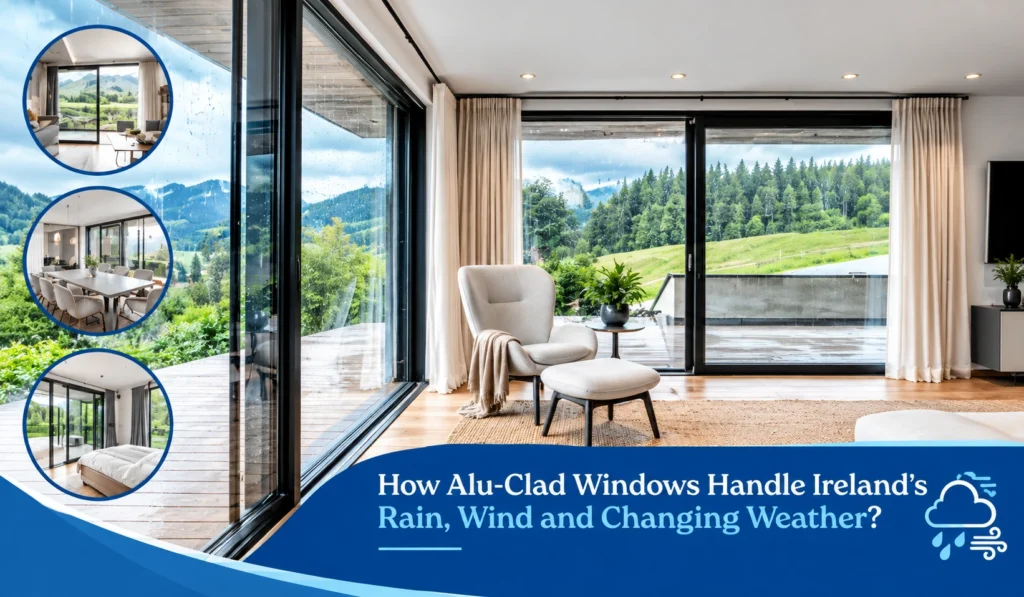
Every Dublin homeowner knows the feeling – a damp patch forming beside the window frame, a draught coming through on a wet November evening, or paint peeling off the exterior sill after another wet winter. These are not random problems. They are what happens when windows are not built to handle Irish weather properly.
Ireland’s Atlantic climate is one of the most demanding in Europe for windows. Sustained wind-driven rain, salt air from the coast, rapid temperature changes, and occasional frost all attack window frames from different angles. Choosing the wrong material means ongoing maintenance costs, rising energy bills, and early replacement.
If you are looking for a window built specifically to handle all of this, alu-clad windows are worth a close look.
What Are Alu-Clad Windows?
Alu-clad windows combine two materials in one frame, each placed where it performs best:
- Inner frame: Solid timber – naturally warm, an excellent insulator, and comfortable to touch on the room side
- Outer cladding: A precision-fitted aluminium shell that covers the timber entirely on the exterior face
The timber never contacts the weather. The aluminium never needs repainting. This is not a compromise – it is purposeful engineering. The warmth and insulation of wood where you live, and the toughness of metal where the weather hits.
At ThermoGlaze, our alu-clad window range is sourced exclusively from Internorm and Dako – two of Europe’s most respected window manufacturers. Both brands engineer their products specifically for northern European weather conditions. That matters in Ireland, where the weather is not mild – it is persistent.
Why Does Ireland’s Weather Demand a Tougher Window?
Based on what our team sees during surveys and call-outs across Dublin every week, these are the four most common ways Irish weather damages window frames:
1. Wind-Driven Rain Penetration
In Ireland, rain frequently arrives horizontal. Atlantic low-pressure systems drive water sideways at force, pushing it into any gap around a frame, sash, or seal. This is the single most common cause of damp ingress around windows in Irish homes – and it is entirely preventable with the right frame construction and seal system.
2. Daily Temperature Cycling
Dublin temperatures regularly move 10°C or more between morning and afternoon. This constant expansion and contraction fatigues window seals and frame joints over time. Frames that cannot flex consistently lose their seal within a decade, letting cold air and moisture in.
3. Salt Air Along the Coast
Homes within a few kilometres of Dublin Bay – Clontarf, Raheny, Sandymount, Malahide – face accelerated deterioration from salt-laden air. Exposed materials degrade faster here than in inland areas, making the choice of exterior material especially important for coastal Dublin properties.
4. UV Degradation Over Time
Ireland’s summer UV levels are higher than many homeowners expect, and the effect on window frames compounds over years. Frames that cannot handle sustained UV exposure fade, chalk, and weaken – adding to maintenance costs and reducing kerb appeal.
How Alu-Clad Windows Handle Each of These Challenges?
This is where the construction earns its place in Irish homes.
Handling Wind-Driven Rain
The aluminium cladding is factory-formed directly to the timber frame, leaving no exposed wood on the exterior face. Multi-chamber profiles and precision compression gaskets maintain a watertight seal even under sustained lateral rain. There are no exposed timber edges to absorb moisture, no paint film that can crack and let water track into the wall cavity. Our Dublin customers consistently report zero damp ingress around alu-clad frames – even on west-facing elevations that take the full force of Atlantic weather.
Handling Temperature Changes
The solid timber inner frame acts as a natural thermal break. It flexes slightly with temperature changes without stressing the seal or pulling the frame out of square. Combined with double or triple glazing options, alu-clad frames from Internorm and Dako achieve low U-values – the standard measure of heat loss through a window – which directly reduces home heating costs and can support SEAI home energy upgrade grant applications when the right specification is chosen.
Handling Coastal Salt Air
The powder-coat finish on the aluminium exterior is applied under factory conditions and bonds at a molecular level. It does not corrode, blister, or lift in salt-laden air. The timber underneath remains completely protected. For homeowners in Clontarf, Portmarnock, or Sandymount, this is one of the most practical reasons to choose alu-clad – the exterior looks the same after 15 years as it did on installation day.
Handling UV and Long-Term Colour Stability
The powder-coat exterior holds its colour without chalking, fading, or peeling, regardless of UV exposure. There is no maintenance cycle required – no sanding, no primer, no repainting. A wash with warm water once or twice a year keeps the frames looking exactly as installed. The interior timber finish is equally durable and can be painted or stained to your preference without any impact on exterior performance.
Key Benefits of Alu-Clad Windows for Irish Homes
- Long lifespan: Internorm and Dako alu-clad windows are engineered for 40 to 50 years under normal Irish conditions
- Very low maintenance: No exterior painting, resealing, or specialist treatment required
- Strong thermal performance: Low U-values reduce heat loss and cut energy bills year-round
- Custom sizing: Both manufacturers offer made-to-measure frames – important for older Dublin homes where window openings are not standard dimensions
- Wide colour range: Powder-coat aluminium exterior available across the full RAL colour spectrum; interior timber stained or painted to match your décor
- Sustainable materials: Timber sourced from managed forests; aluminium fully recyclable at end of life
- SEAI compatibility: The right glazing specification can meet SEAI U-value thresholds for home energy upgrade grants
Why ThermoGlaze for Alu-Clad Windows in Dublin?
ThermoGlaze has been supplying and fitting windows and doors across Dublin for over 20 years. We work directly with homeowners – not through subcontractors – on everything from single window replacements to full house re-glazing projects.
Our customers in coastal Dublin suburbs consistently report that alu-clad frames from Internorm and Dako show no visible deterioration after 10 or more years – no corrosion, no seal failure, no colour change. That is the kind of real-world performance that a brochure cannot fully convey.
Every job starts with a proper site survey. We measure your openings, assess the exposure conditions of your property, and recommend the glazing specification that fits your home and budget – not the one that suits our margin. You can request a free quote online and we will arrange a visit at a time that suits you.
Visit Our Dublin Showrooms
Seeing and handling a window in person before you commit is something we strongly recommend. Both showrooms carry live examples of the alu-clad range alongside our full window and door collections.
ThermoGlaze Showrooms:
- Swords: Unit F2, Swords Enterprise Park, Feltrim Road, Swords, Co. Dublin K67 WF72
- Rathgar: 68 Rathgar Avenue, Dublin 6, D06 KN53
No appointment needed. Drop in during opening hours and one of the team will walk you through the options.
Conclusion
Alu-clad windows are built for exactly the conditions Irish homes face every year. The aluminium exterior takes the rain, wind, salt air, and UV. The timber interior holds warmth and keeps the home comfortable. With a lifespan of 40 to 50 years and near-zero maintenance, they are a sound long-term investment for any Dublin homeowner.
ThermoGlaze supplies Internorm and Dako alu-clad windows across Dublin, backed by our own installation team and two city showrooms. Call 01 912 0600 or visit the ThermoGlaze contact page to get started.
FAQs
1. Are alu-clad windows built to handle Irish weather conditions?
Yes. The combination of aluminium exterior and timber interior is purpose-built for northern European conditions – persistent rain, coastal wind, and temperature swings. It is the window type we most commonly recommend for exposed Dublin properties.
2. How does the aluminium exterior protect the timber frame?
The aluminium cladding is factory-fitted to the timber frame, covering it completely on the exterior face. No timber is exposed to rain, wind, UV, or salt air. The timber remains fully protected and structurally sound for the life of the window.
3. Do alu-clad windows need painting or resealing?
No. The exterior aluminium carries a factory powder-coat finish that requires no repainting. The interior timber is protected from weather and only needs attention if you choose to change the interior colour or finish.
4. How long will alu-clad windows last in a Dublin home?
Internorm and Dako alu-clad windows are engineered for a 40 to 50 year lifespan under normal Irish conditions. Our customers with 10 to 15 year old installations report no visible deterioration on the exterior frame or seals.
5. Can alu-clad windows support a SEAI grant application?
Windows that meet the required U-value threshold can qualify under SEAI home energy upgrade grants. The specific specification depends on the glazing package chosen. Our team advises on this during the survey visit at no obligation.
6. Are alu-clad windows suitable for period or older Dublin homes?
Yes. Both Internorm and Dako supply custom sizes, which is important for older terraced homes where window openings are not standard dimensions. The interior timber finish can also be specified to complement period interiors.
7. What colours are available for the aluminium exterior?
The powder-coat finish is available across a wide RAL colour range – from white and light grey through to anthracite, black, and bespoke shades. The interior timber is painted or stained separately to your preference and specification.
8. How do alu-clad windows perform in coastal areas of Dublin?
Very well. The factory powder-coat aluminium resists salt-air corrosion reliably over the long term. We regularly install these in Clontarf, Malahide, Portmarnock, and Sandymount and have strong feedback on long-term performance from those customers.
9. How does the ThermoGlaze installation process work?
We start with a free site survey – measuring openings, assessing your property’s exposure, and advising on the right specification. Installation is carried out by our own team. Request a free quote to book your survey.
10. Where can I see alu-clad windows before buying?
Visit either of our Dublin showrooms – Swords (K67 WF72) or Rathgar (D06 KN53) – to see and handle the Internorm and Dako range in person. Call 01 912 0600 if you want to check availability before travelling.