

Yes – modern aluminium bi-fold doors work well in the Irish climate, provided they have thermally broken frames, multi-point locking, proper compression seals, and a glazing unit with a U-value of 1.4 W/m²K or lower. Poorly specified or cheaply made bi-fold doors will underperform in Ireland’s wet, windy, and humid conditions. The difference comes down to product quality and correct installation.
Bi-fold doors have become one of the most popular rear-of-house upgrades in Dublin over the past decade. You’ll find them opening kitchens into garden rooms in Rathgar, connecting dining areas to rear extensions in Clontarf, and replacing dated patio doors in homes from Swords to Donnybrook. But Ireland’s climate – persistent rain, strong Atlantic winds, high humidity, and relatively cold winters – raises a legitimate question: do bi-fold doors actually hold up here, or are you buying a draught problem?
This guide answers that question in full. We cover the technical standards that matter for the Irish market, explain the key terms in plain language, and show you what to look for when choosing bi-fold doors for your Dublin home.
What Does the Irish Climate Actually Do to Bi-Fold Doors?
Ireland has a temperate oceanic climate (Köppen classification: Cfb). That means:
- Average winter temperatures in Dublin hover between 4°C and 8°C – not extreme, but cold enough to expose poor insulation
- Annual rainfall in Dublin averages around 700–750mm, spread across roughly 150 rain days per year
- Relative humidity regularly exceeds 80%, creating persistent condensation risk on cold glazing surfaces
- Wind is a year-round factor, particularly on north- and west-facing elevations and in more exposed suburban or coastal locations
Each of these factors puts a specific demand on bi-fold doors. Rain penetration resistance depends on threshold design and panel seals. Thermal comfort depends on frame and glass specification. Condensation risk is managed through thermally broken profiles and warm-edge spacer bars in the glazing unit. Wind resistance depends on multi-point locking and the structural integrity of the frame.
A well-specified aluminium bi-fold door handles all four. A poorly specified one fails on at least one.
Key Terms Explained: What You Need to Know Before Buying
What Is a U-Value?
U-value is the measure of heat transfer through a building element – in this case, a door – expressed in watts per square metre per kelvin (W/m²K). The lower the U-value, the slower heat escapes and the better the insulation performance.
For context: a single-pane glass door from the 1970s might have a U-value of 5.0 W/m²K or higher. A modern double-glazed aluminium bi-fold door should sit at 1.4 W/m²K or below. The best performing triple-glazed systems reach 0.8 W/m²K or lower.
Irish building regulations (under Technical Guidance Document L, Part L of the Building Regulations) set a maximum U-value of 1.4 W/m²K for replacement windows and doors in existing dwellings. New build standards are stricter. Any bi-fold door that fails to meet this figure is non-compliant with Irish regulations.
What Is a Thermal Break?
A thermal break is a low-conductivity insert – typically a reinforced polyamide strip – placed through the centre of an aluminium frame profile to interrupt the conductive path between the outer cold face and the inner warm face of the frame.
Standard aluminium conducts heat at approximately 160 W/mK. Polyamide thermal break material conducts at roughly 0.3 W/mK – around 500 times slower. This single engineering detail is what separates a warm, comfortable aluminium bi-fold door from a cold, condensation-prone one.
Without a thermal break, the aluminium frame acts as a direct bridge between the cold outdoors and your warm interior. In Irish conditions – where outdoor temperatures in January and February regularly sit at 4°C to 6°C – this means cold frame surfaces, condensation on the inside of the frame, and accelerated heat loss from the room.
What Are Compression Seals and Why Do They Matter?
Compression seals are continuous gaskets running the full height of each panel junction in a bi-fold door. When the door is closed and locked, the panels compress against these seals, creating an airtight barrier that resists wind-driven rain and cold air infiltration.
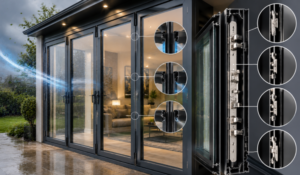
In a multi-panel bi-fold door, you have more panel junctions than in a standard hinged or sliding door – which means more potential paths for draughts if the seals are poor quality or if the locking hardware doesn’t pull the panels tight. Multi-point locking systems address this by engaging multiple lock points simultaneously along the height of the door, ensuring the seal is consistent top to bottom.
U-Value Comparison Table: Bi-Fold Doors in Context
| Door Type | Typical U-Value (W/m²K) | Meets Irish Regs? | Notes |
| Single-glazed aluminium (old) | 4.5–5.5 | No | Common in pre-1990s homes |
| Standard uPVC double glazed | 1.4–1.8 | Marginal | Depends on glass spec |
| Aluminium bi-fold, standard double glazed | 1.4–1.6 | Yes | Requires thermally broken frame |
| Aluminium bi-fold, argon-filled double glazed | 1.1–1.4 | Yes | Low-E coating adds further benefit |
| Aluminium bi-fold, triple glazed | 0.7–1.0 | Yes (exceeds regs) | Best for passive house or high BER targets |
| Lift and slide doors | 0.8–1.2 | Yes | Alternative for exposed sites |
Are Modern Bi-Fold Doors Draughty? The Straight Answer
Modern, well-made bi-fold doors are not inherently draughty. Draughts in bi-fold doors are a product quality and installation issue, not a design flaw.
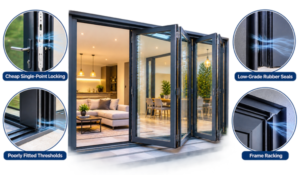
The scenarios where draughts occur include:
- Cheap single-point locking that pulls panels tight at one point only, leaving gaps at the top and bottom of each panel junction
- Low-grade rubber seals that compress permanently after a few seasons and no longer form an airtight contact
- Poorly fitted thresholds that leave a gap between the bottom of the door and the floor, particularly on uneven substrates
- Frame racking caused by incorrect installation on out-of-square openings, which prevents the panels from sitting flush when closed
The ThermoGlaze Silka bi-fold range addresses each of these with steel wheel rolling mechanisms for long-term tracking accuracy, high-security multi-point locking that pulls the full panel height tight against its seals, and a low-threshold or external cill option that manages the gap at floor level in line with Irish accessibility and weatherproofing requirements.
What Glazing Specification Suits Irish Conditions?
The glass unit does the majority of the thermal work in a bi-fold door. For Irish conditions, look for:
- Argon gas fill between panes – argon conducts heat at roughly half the rate of air, reducing the U-value of the glass unit alone by around 0.2–0.3 W/m²K
- Low-E (low emissivity) coating – a microscopically thin metallic coating on the inner glass surface that reflects long-wave heat radiation back into the room. Soft-coat low-E is the more effective option; it’s typically found in higher-specification units
- Warm-edge spacer bars – the bar holding the two panes apart. Traditional aluminium spacers conduct cold from the edge of the glass inward, creating cold strips and condensation along the sight lines. Warm-edge spacers (made from polymer or composite materials) interrupt this path
- Triple glazing – adds a third pane and a second gas-filled cavity. In Irish new build or deep retrofit contexts, triple glazing is increasingly specified as standard and directly supports BER rating improvement
For most Dublin homes replacing old patio or French doors with bi-folds, a thermally broken aluminium frame with argon-filled, low-E double glazing will comfortably meet building regulations and deliver a meaningful improvement in thermal comfort.
How Bi-Fold Doors Affect Your BER Rating?
A BER (Building Energy Rating) is Ireland’s standardised measure of a home’s energy performance, assessed on a scale from A1 (most efficient) to G (least efficient). BER ratings are required when selling or renting a property in Ireland, and they directly affect property value and mortgage eligibility under green finance products.
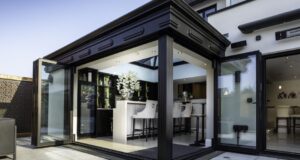
Replacing single-glazed or poorly insulated doors with a compliant bi-fold door system can contribute to BER improvement by:
- Reducing the overall heat loss coefficient (HLC) of the dwelling
- Improving the fabric energy efficiency score in the Deap (Dwelling Energy Assessment Procedure) calculation
- Supporting the case for a higher BER band alongside other upgrades such as wall insulation or heat pump installation
If you are planning a full retrofit or extension in Dublin, combining bi-fold door installation with SEAI grant-eligible upgrades is the most cost-effective approach. SEAI (Sustainable Energy Authority of Ireland) provides grants for window and door upgrades in existing homes that meet its technical specifications – check current eligibility before ordering.
Bi-Fold Doors and Period Dublin Homes
Many Dublin homeowners asking about bi-fold doors live in Georgian, Victorian, or Edwardian properties – particularly in south Dublin suburbs such as Rathgar, Ranelagh, Rathmines, Donnybrook, and Clontarf. These homes present specific considerations:
- Planning permission may be required for bi-fold doors visible from the public road, particularly in Architectural Conservation Areas (ACAs). Rear installations typically do not require permission, but always check with Dublin City Council or your local authority
- Colour choice matters – anthracite grey and black aluminium are generally more sympathetic to the character of period properties than silver or bronze and are more likely to satisfy planning requirements in ACAs
- Opening size – Victorian and Edwardian rear returns often have narrower openings. Bi-fold doors with individual leaf widths from 600mm upward can be configured to fit smaller apertures without requiring structural alterations
ThermoGlaze’s Silka bi-fold doors are available in any RAL colour, with white, black, and anthracite grey held in stock for immediate manufacturing. This matters if you’re working to a construction programme on an extension project and need to avoid long lead times.
Bi-Fold Doors vs. Other Door Types for Irish Homes
| Door Type | Thermal Performance | Draught Resistance | Best Application | Irish Climate Suitability |
| Aluminium bi-fold (thermally broken) | Good–Excellent | Good (well-made) | Rear extensions, open-plan kitchens | Good for sheltered sites |
| Patio doors | Good | Very Good | Narrower openings, exposed elevations | Excellent |
| French doors | Good | Good | Period homes, smaller openings | Very Good |
| Lift and slide | Excellent | Excellent | Exposed or coastal sites | Excellent |
| uPVC doors | Good | Very Good | Budget retrofits | Very Good |
| Aluminium doors | Good–Excellent | Very Good | Modern builds, commercial | Excellent |
What to Check Before You Buy Bi-Fold Doors in Ireland?
Before committing to any bi-fold door system, ask your supplier these questions:
- What is the overall door U-value, including frame? (Not just the glass unit – the frame matters too)
- Is the frame thermally broken? If yes, what is the thermal break material and width?
- What type of locking system is fitted? Multi-point locking is the minimum standard for security and weatherproofing
- What threshold options are available? Low-threshold and rebated options suit Irish conditions better than a flat threshold with no upstand
- Is the door CE marked? CE marking indicates the product has been tested to European performance standards covering air permeability, water tightness, and wind resistance
- What is the warranty on seals and mechanisms?
Get a quote from ThermoGlaze and our team will walk you through each of these points for your specific opening and site.
Conclusion
Bi-fold doors are a practical, weather-resistant choice for Irish homes – but only when they’re specified correctly. The key factors are a thermally broken aluminium frame, multi-point locking, quality compression seals, argon-filled glazing with a low-E coating, and a U-value at or below 1.4 W/m²K to meet Irish building regulations. A door that ticks all of these boxes will keep your home warm, dry, and draught-free through a Dublin winter while giving you full indoor-outdoor access in the warmer months.
At ThermoGlaze, we supply and install bi-fold doors across Dublin from our two showrooms. You can see the Silka bi-fold range in person, talk through the specification for your home, and get a written quote with no obligation.
Call us on 01 912 0600 or visit either showroom:
Swords (Northside): Unit F2, Swords Enterprise Park, Feltrim Road, Drinan, Swords, Co. Dublin, K67 WF72
Rathgar (Southside): 68 Rathgar Avenue, Dublin 6, D06 KN53
FAQs
Q1. Do bi-fold doors work in Ireland’s wet weather?
Yes. Modern aluminium bi-fold doors with compression seals, multi-point locking, and a rebated or low threshold are designed to resist rain penetration. The key is buying a door that has been tested to European standards for water tightness (Classification W to EN 12208) rather than a cheaper unclassified product.
Q2. What U-value do bi-fold doors need to meet Irish building regulations?
Under Irish building regulations (Part L, Technical Guidance Document L), replacement windows and doors must achieve a maximum U-value of 1.4 W/m²K. New builds are subject to stricter requirements. A good quality thermally broken aluminium bi-fold with argon-filled, low-E double glazing will typically achieve 1.1–1.4 W/m²K, which exceeds the minimum standard.
Q3. Are bi-fold doors draughty in Ireland?
Poorly made bi-fold doors can be draughty – but this is a product quality issue, not an inherent feature of the design. Well-made bi-fold doors with multi-point locking, full-height compression gaskets, and correctly fitted thresholds perform well in Irish draught and wind conditions.
Q4. What is a thermal break in an aluminium bi-fold door?
A thermal break is a strip of low-conductivity material – usually reinforced polyamide – inserted through the centre of an aluminium frame profile. It separates the cold outer face of the frame from the warm inner face, reducing heat loss and preventing condensation on the interior of the frame. All good quality aluminium bi-fold doors sold in Ireland should have thermally broken frames as standard.
Q5. Can I get an SEAI grant for bi-fold doors in Ireland?
SEAI (Sustainable Energy Authority of Ireland) provides grants for window and door upgrades in existing dwellings. The installation must meet SEAI’s technical specification requirements, including U-value targets. Contact ThermoGlaze on 01 912 0600 to find out whether your project qualifies under current SEAI grant terms.
Q6. Do bi-fold doors need planning permission in Dublin?
Rear bi-fold door installations generally do not require planning permission under the exempted development provisions of the Planning and Development Regulations. However, properties in Architectural Conservation Areas (ACAs) or those subject to planning conditions may have restrictions. Always check with Dublin City Council or your local authority before proceeding.
Q7. What is the best glazing for bi-fold doors in Ireland?
For Irish conditions, the best glazing specification for bi-fold doors is argon-filled double glazing with a soft-coat low-E (low emissivity) coating and warm-edge spacer bars. This combination typically delivers a glass unit U-value of around 1.0–1.1 W/m²K. Triple glazing is available for higher-performance requirements such as passive house builds or BER A-rating targets.
Q8. Are aluminium bi-fold doors suitable for period homes in Dublin?
Yes. Aluminium bi-fold doors in anthracite grey or black are widely used in Georgian, Victorian, and Edwardian Dublin homes, particularly for rear extensions. The slim sightlines of aluminium frames suit the architectural proportions of these properties better than bulkier uPVC frames. ThermoGlaze supplies bi-fold doors in a full RAL colour range with black and anthracite grey available from stock.
Q9. How wide can bi-fold doors be in a standard Dublin rear extension?
ThermoGlaze Silka bi-fold doors are available with individual leaf widths up to 1.2m and heights up to 3m as standard. Multiple panel configurations are possible, including corner openings where two walls meet. The total opening width depends on the number of panels – a four-panel system, for example, can span up to approximately 4.8m before structural lintels become a significant factor.
Q10. Where can I see bi-fold doors on display in Dublin?
ThermoGlaze has two showrooms in Dublin where you can view bi-fold doors in person. The Swords showroom is at Unit F2, Swords Enterprise Park, Feltrim Road, Swords, Co. Dublin (K67 WF72) and serves the northside. The Rathgar showroom is at 68 Rathgar Avenue, Dublin 6 (D06 KN53) and serves the southside. Call 01 912 0600 before visiting to confirm availability.