
If you have been looking at window options for a new build or home upgrade in Dublin, tilt & turn windows have probably come up. From the outside they look like a standard casement window, but the way they operate is completely different – and far more practical for Irish homes and apartments.
This guide covers exactly what tilt & turn windows are, how the mechanism works in both modes, why they suit Dublin properties so well, and what the installation process actually involves.
What Are Tilt & Turn Windows?
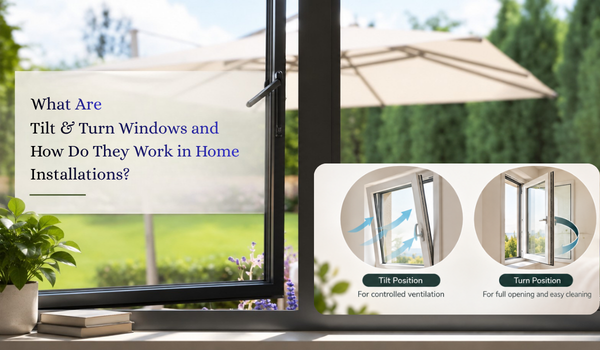
Tilt & turn windows are a style of window that opens in two distinct ways using a single handle. One turn of the handle tilts the top of the sash inward for background ventilation. A further turn of the same handle opens the entire sash inward like a door, giving you full access to the opening for cleaning or maximum airflow.
This dual-mode operation is what separates them from traditional outward-opening casement windows. They have been standard across Continental Europe for decades and are now a popular choice among Dublin homeowners – particularly for apartments, modern extensions, and energy-conscious builds where safety, easy maintenance, and controlled ventilation are priorities.
How Do Tilt & Turn Windows Work?
The entire mechanism runs off a single multi-point locking handle. Here is what happens at each position.
Tilt Mode – Handle Turned Upward
- The top of the sash tilts inward at an angle of roughly 10–15 degrees
- Fresh air enters from the gap at the top, creating a natural flow without direct wind exposure
- Because the gap faces inward and upward, rain cannot easily drive through it
- The window remains secure – the opening is too narrow for anyone to reach through or push further open from outside
Tilt mode is the setting most people use day-to-day. You can leave the window in tilt overnight in a bedroom or bathroom without any real security concern.
Turn Mode – Handle Turned Sideways
- The sash pivots on its bottom hinge and swings fully inward like an internal doors
- Both faces of the glass are accessible from inside the room – no ladders required
- Airflow is at its maximum, useful for airing out kitchens or living rooms quickly
- In upper-floor rooms, this position also provides emergency egress, which is relevant for building regulations compliance
Closed and Locked – Handle Pointing Downward
- The multi-point locking system engages simultaneously at the top, bottom, and sides of the frame
- The window is fully sealed and locked – the most secure position
Tilt Mode vs Turn Mode at a Glance
| Feature | Tilt Mode | Turn Mode |
| Opening direction | Top tilts inward | Full sash swings inward |
| Ventilation level | Low to moderate | High |
| Rain protection | Good – angled gap faces inward | Close in rain |
| Security | High – gap too narrow to force | Moderate – depends on locking |
| Cleaning access | Partial | Full – both panes from inside |
| Best used for | Day-to-day ventilation | Thorough airing or cleaning |
Why Dublin Homeowners Choose Tilt & Turn Windows?
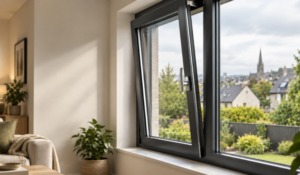
Irish weather is unpredictable at the best of times. A window you can leave open on a damp morning without worrying about rain driving in is genuinely useful here. Beyond that, there are several practical reasons why tilt & turn windows suit Dublin homes.
Energy Efficiency
Tilt & turn windows are supplied with double or triple glazing and thermally broken frames, keeping U-values low. This matters if your home is working toward a better BER rating or if you are planning to apply for an SEAI grant to offset some of the upgrade cost.
Safety – Especially on Upper Floors
Because the window opens inward rather than outward, there is no risk of the sash catching in strong wind or swinging out above a drop. The tilt function gives background ventilation while keeping the gap small – a real advantage in children’s bedrooms or apartments above ground floor.
Easy Cleaning Without Ladders
Cleaning the external face of a first or second-floor window is genuinely awkward with traditional outward-opening windows. In turn mode, the sash swings fully inward and you can wipe both faces of the glass from inside the room. It is one of those practical details that makes a real difference over time.
Strong Security
Multi-point locking engages at the top, bottom, and both sides of the frame simultaneously when the window is closed. This is significantly more secure than a single-point latch on a standard casement. In tilt mode, the window cannot be pushed open further without breaking the frame.
Suits a Wide Range of Dublin Properties
Whether you are fitting out a new build in Swords, replacing old windows in a semi-detached in Rathgar, or upgrading an apartment in the city centre, tilt & turn windows are practical across all of these settings. They work in any room and adapt well to both period and contemporary properties.
What Frame Materials Are Available?
At ThermoGlaze, tilt & turn windows are offered as part of the alu-clad windows range – combining an aluminium exterior shell for durability and weather resistance with a timber-effect or colour-finished interior. This gives you the robust performance of aluminium facing the elements while keeping a clean, modern look inside.
If you are considering other high-performance options alongside tilt & turn, it is worth looking at aluminium windows or uPVC windows to compare specifications for your specific project.
How Are Tilt & Turn Windows Installed?
Installation follows the same general process as any replacement or new-build window, with a few extra considerations because of the inward-opening mechanism.
Step 1 – Survey and Measurement
A surveyor visits your property to measure each opening. Because the sash swings inward in turn mode, the amount of clearance in front of the window needs to be confirmed at this stage – furniture, radiators, and deep window boards all need to be accounted for.
Step 2 – Frame Removal for Replacements
For replacement projects, the existing frame is removed carefully. In older Dublin homes this stage sometimes reveals issues with the surrounding reveal or structural lintel that need sorting before the new frame is fitted.
Step 3 – Frame Installation
The new frame is fixed into the opening, levelled, and sealed. Thermally broken frames are installed with care to avoid cold bridges at the edges, which would undermine the glazing unit’s U-value.
Step 4 – Glazing and Hardware
The glazed unit is installed into the frame and all hardware – hinges, handle, multi-point locking points – is fitted and tested. Both tilt and turn functions are checked and adjusted before the installer leaves.
Step 5 – Finishing and Handover
Internal and external reveals are finished, sealed, and cleaned up. Before leaving, our installer walks you through how to operate both modes and the locking mechanism correctly.
For new build projects, frames are typically installed earlier in the build sequence, before internal plastering, and glazed units go in at a later stage.
Rooms Where Tilt & Turn Windows Work Best
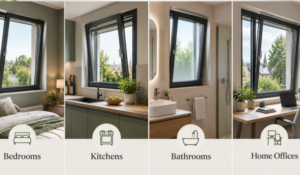
- Bedrooms – tilt mode gives overnight ventilation without leaving a large open gap
- Kitchens – turn mode clears steam and cooking smells quickly; easy to clean around splashbacks
- Bathrooms – tilt mode handles moisture without creating a draught
- Home offices – fresh air without the noise of a fully open window
- Apartments – where outward-opening windows may not be permitted or practical over shared walkways
Tilt & Turn vs Casement Windows – Which Suits Your Home?
| Factor | Tilt & Turn | Casement |
| Opening direction | Inward – two modes | Outward – single mode |
| Cleaning ease | Both panes from inside | External access needed on upper floors |
| Ventilation control | Two distinct settings | One open position |
| Apartments / upper floors | Well suited | Sometimes restricted |
| Child safety | High – tilt gap is small | Moderate |
| Internal clearance needed | Yes – for inward swing | No |
If you are undecided, take a look at our casement windows page alongside the tilt & turn option, or speak to the team at either showroom who can advise on what suits each room.
Maintenance – Keeping Tilt & Turn Windows in Good Shape
Tilt & turn windows are low maintenance, but a few simple habits will keep them running smoothly.
- Lubricate hinges and locking points once a year with a silicone-based spray – avoid oil-based products on aluminium or uPVC frames
- Check rubber gaskets around the frame annually; replace if cracked or hardened
- Clear the drainage channels at the bottom of the frame to prevent water build-up
- Clean the frame surface with a soft cloth and mild soapy water – no abrasive cleaners
- Test the multi-point lock periodically to confirm it engages cleanly at all points
Visit Our Dublin Showrooms
Seeing tilt & turn windows in person before committing makes a genuine difference. You can feel the handle mechanism, operate both modes, and get a real sense of the inward clearance they need in a room.
ThermoGlaze has two showrooms across Dublin where the full range is on display and the team is available to talk through specifications, glazing options, and lead times.
Northside – Swords Showroom
Unit F2, Swords Enterprise Park, Feltrim Road, Drinan, Swords, Co. Dublin, K67 WF72
Southside – Rathgar Showroom
68 Rathgar Avenue, Dublin 6, D06 KN53
No appointment necessary – walk in and take your time. If you want to book ahead, call us on 01 912 0600.
Get a Free Quote Today
If tilt & turn windows are the right fit for your home, getting started is simple. Call 01 912 0600, drop in to either showroom, or request a free quote online. We cover all of Dublin – Swords, Blanchardstown, Rathgar, Clontarf, Donnybrook, Drumcondra, Raheny, and every suburb in between.
Conclusion
Tilt & turn windows are one of the most practical window choices for Irish homes. The two-mode mechanism gives you proper ventilation control for everyday use, makes cleaning genuinely straightforward without external access, and delivers multi-point security that standard casement windows cannot match. They suit any room, work across different property types, and – when fitted with quality glazing and thermally broken frames – contribute meaningfully to a home’s energy performance.
If you are planning a window replacement or new build in Dublin and want windows that do more than simply open and close, tilt & turn windows are worth a serious look. Visit one of our two Dublin showrooms, call us on 01 912 0600, or head to thermoglaze.ie to explore the full range and request your free no-obligation quote.
FAQs
1. What are tilt & turn windows?
Tilt & turn windows open in two ways using one handle. Turning the handle up tilts the top of the sash inward for ventilation. Turning it sideways opens the full sash inward like a door for maximum airflow and cleaning access.
2. How does the tilt function work?
The tilt mechanism releases the top of the sash while keeping the bottom hinges engaged. The window opens inward at the top by roughly 10–15 degrees, allowing fresh air in while staying secure and protected from rain.
3. Are tilt & turn windows secure?
Yes. When closed, multi-point locks engage around the full perimeter of the frame. In tilt mode the gap is too narrow to force wider from outside without breaking the frame.
4. Can I clean them from inside without a ladder?
Yes – this is one of their biggest practical advantages. In turn mode the sash swings fully inward and you can reach both faces of the glass from inside the room.
5. Are they suitable for upstairs rooms?
Particularly so. They open inward, removing risk above a drop, and tilt mode provides overnight ventilation without leaving a wide open gap – ideal for children’s bedrooms.
6. Do tilt & turn windows require planning permission in Dublin?
Like-for-like window replacements generally do not require planning permission. Properties in conservation areas or protected structures may need to check with their local authority first.
7. Are tilt & turn windows energy efficient?
When paired with double or triple glazing and thermally broken frames, they achieve low U-values, supporting better BER ratings and potential eligibility for an SEAI energy grant.
8. What is the difference between tilt & turn and casement windows?
Casement windows open outward on side hinges. Tilt & turn windows open inward in two modes. Tilt & turn offer better cleaning access, safer upper-floor use, and more ventilation control, but require clearance inside the room.
9. How long does installation take?
A single window replacement typically takes a few hours. A full-house installation usually runs one to two days depending on the number of windows and the condition of existing frames.
10. Where can I see tilt & turn windows on display in Dublin?
ThermoGlaze has showrooms in Swords (Unit F2, Swords Enterprise Park) and Rathgar (68 Rathgar Avenue, Dublin 6). Call ahead on 01 912 0600 or visit during opening hours – no appointment needed.